The Agentification Decision: Making the Call on What to Automate, Augment, and Protect
The Agentification Decision Series
The question facing product marketing leaders right now is not whether to adopt AI. That decision has usually already been made, often a level or two above you, sometimes in a board meeting where "how are we using AI" got asked and nobody wanted to answer with silence. The question that actually matters is narrower and harder to answer well: which parts of your function should run without you.
Most PMM conversations about AI never reach that question. They stall at the tool layer. Which writing assistant, which competitive-intelligence platform, which meeting summarizer. Tools are the easy part, and they are also the part least likely to change how the function performs. A team that buys ten AI tools and points them at the same disorganized work produces the same disorganized work, only faster.
I've argued before that AI won't replace product marketing judgment. That earlier post drew the boundary in principle: some work should be automated, some augmented, some kept firmly in human hands. This is the operational sequel. It gives you a method for deciding which of your programs belong in which zone, then applies that method to a full 68-asset PMM operating system so you can see what the answer looks like when someone actually does the work.
The tool question is the wrong question
A product marketing function is not a collection of tools. It's a portfolio of programs, and the programs have very different shapes. Some are high-volume production work, like one-pagers and solution briefs. Some are continuous monitoring, like competitive intelligence. Some are once-a-year strategic calls made in a room with the CRO, the CFO, and the CEO. Buying an AI tool treats all of that as one undifferentiated pile labeled "marketing." Deciding what to agentify treats it as what it is: a set of distinct programs, each with its own automation profile.
That reframe is the whole game. The question is not "what can AI do for product marketing," which is a capability question a vendor can answer. The question is "what should run agentically inside my function, and what must not," which is an architecture question only the PMM leader can answer. Architecture is the job. When a leader outsources it to whichever tool demoed best, they have not adopted AI. They have abdicated a decision.
The lens I use sorts every program into one of three zones. In the Automate zone, an agent runs the work end to end and a human reviews output rather than producing it. In the Augment zone, the agent does substantial work but a human stays in the loop on interpretation and the decisions that follow. In the Protect zone, the work stays human, because handing it to an agent would strip out the judgment or the accountability that is the entire reason the work exists. Every program lands somewhere on that spectrum. The discipline is refusing to guess, and scoring instead.
The rubric: six dimensions, and the two everyone forgets
Scoring needs criteria. I assess each program against six dimensions.
The first four are the ones most people already reach for. Automation potential: how much of the core work an agent can actually execute, not in a demo but in production. Business impact: what agentifying this program does to revenue, win rate, or pipeline if it's done well. Time savings: hours reclaimed each cycle. Cost savings: the labor cost that agentification offsets.
The last two are the ones that separate a real decision framework from a wish list.
Agent resource cost is the token and compute intensity of running the workflow, multiplied by how often it runs. This matters because it inverts the naive conclusion. A competitive-monitoring agent scanning six competitors across three regions on a continuous basis can be spectacular on impact and time savings and still be a poor first move, because the resource cost of running it continuously outweighs the return until the program matures. Ignore this dimension and you will greenlight workflows that quietly bleed budget while a finance leader who has started watching the AI line item loses patience.
Run cadence is how often the workflow should fire: continuous, daily, weekly, monthly, quarterly, or on an event trigger. Cadence is descriptive rather than scored, but it's the dimension that turns an assessment into an operating plan. It's also where the resource-cost tension resolves. A program that would be too expensive to run continuously is often entirely sensible run weekly, and a program's correct cadence frequently changes as the function grows.
That distinction undoes the binary thinking most AI content relies on. Agentification is not a switch. Many programs should start as light augmentation, precisely because the resource cost of full automation isn't justified at current scale, and then graduate toward fuller automation as volume grows and the economics tip. A rubric that prices in resource cost and cadence lets you see that maturation path. A rubric that scores only impact and time savings cannot, and will push you to over-automate work you can't yet afford to run.
The four gates: how to plan an AI-enabled GTM function
A rubric scores individual programs. It does not, on its own, produce a plan. For that, the assessment moves through four gates in order. Skipping or reordering them is the most common way these efforts go wrong.
Gate one is Score. Every program in the function runs through the six dimensions. No exceptions, including the programs you're certain about, because the certain ones are where intuition most often misleads. Assets you assume are prime automation targets sometimes carry hidden human dependencies, and assets you'd never think to automate sometimes turn out to be mostly mechanical underneath.
Gate two is Qualify. A program clears the bar for AI enhancement only if its automation potential is real and at least one of the impact, time, or cost dimensions lands high, and the resource cost doesn't veto the whole thing. Failing this gate is not a defect. It's a finding. A program can be enormously important to the business and still fail to qualify, which is exactly how the Protect zone gets populated. Qualification is where "not everything should be agentified" stops being a platitude and becomes a specific list.
Gate three is Cluster. This is the gate most teams skip, and skipping it produces the fragmented, tool-by-tool adoption that never adds up to leverage. Qualifying programs rarely stand alone. They share data sources, they feed each other, and the same agent often serves several of them. Competitive intelligence, battlecards, objection handling, and win/loss synthesis are not four separate automation projects. They are one competitive-intelligence engine that happens to produce four kinds of output. Clustering correlated programs into initiatives is what turns a list of automatable tasks into a small number of high-leverage systems worth building properly.
Gate four is Sequence. Build in priority order, highest aggregate value and clearest applicability first. Front-loading the strongest initiatives earns the credibility and the reclaimed hours that fund everything after. Sequencing is also where cadence and resource cost re-enter, because the right first build is often not the highest-impact program in the abstract but the one with the best ratio of impact to cost at your current scale.
Score, Qualify, Cluster, Sequence. I call the full pass an Agentification Audit, and it's the same method whether you run it on a three-person team's handful of programs or on a complete enterprise operating system.
What the audit found
I ran it on the latter. Over the past several months I built out a complete PMM operating system: 68 assets spanning strategic foundation, operational templates, program and enablement infrastructure, and strategic performance management. Roughly a thousand pages of frameworks, playbooks, and measurement systems. Then I ran all 68 through the rubric and the four gates myself, which is the only honest way to test whether a decision framework survives contact with a real inventory.
The scoring is one kind of evidence. Here's another, and it's the one that changed how I think about this. Before I had a formalized program at all, I would not have believed the leverage hiding in a single corner of it. Automating roughly 60% of one Tier 1 launch plan, the tip of the spear of the entire operating framework, has augmented close to a full FTE of work on its own. One asset, partially agentified, returned a person's worth of capacity. The audit is what lets you find the next one deliberately instead of stumbling into it.
The distribution:
Sixteen assets landed in the Automate zone. These are the programs that can run largely agentically with a human reviewing rather than producing: competitive landscape mapping, battlecard maintenance, objection-handling libraries, most short-form collateral, FAQ libraries, win and loss theme synthesis, the metrics dashboard, and the search and email production engines. High automation potential, real impact, and in most cases a resource cost the return comfortably justifies.
Forty-two landed in the Augment zone. This is the largest group by a wide margin, and it's the one the binary conversation erases entirely. These programs get materially faster with an agent doing the heavy lifting on research, drafting, and synthesis, while a human stays responsible for interpretation and the call that follows. ICP segmentation, win/loss analysis, sales plays, the GTM diagnostic, customer expansion, most of the program layer. The agent is a force multiplier here, not an operator.
Ten landed in the Protect zone. Core positioning and messaging. GTM strategy. The PMM operating model and charter. Pricing and packaging. Executive and board communication. Strategic planning. Investor relations. Analyst relations. These did not fail to qualify because AI is incapable of touching them. Current models can draft a positioning document or assemble a board deck. They failed to qualify because the value of the work is the human judgment and accountability inside it, and automating the artifact would hollow out the thing that makes it worth doing.
The honest headline is not the raw count, though in this library fifty-eight of the seventy programs benefited from AI in some form. That ratio is not a law. It shifts with the organization and with the maturity of the underlying PMM program. A less-built-out function will have fewer programs mature enough to automate at all, and a more sophisticated one may push further into the Automate zone than I did here. What travels across organizations is not the number. It's the pattern: the programs that stay human cluster, and where they cluster is telling.
Map the zones against the four layers of the function and the concentration is hard to miss. The operational template layer, the day-to-day production work, holds the largest share of Automate-zone programs and not a single Protect-zone one. The two strategic layers, the foundation everything else is built on and the executive-facing performance work at the top, hold eight of the ten Protect assets between them. The program layer in the middle is almost entirely Augment. Automation lives at the bottom of the stack. Judgment lives at the top.
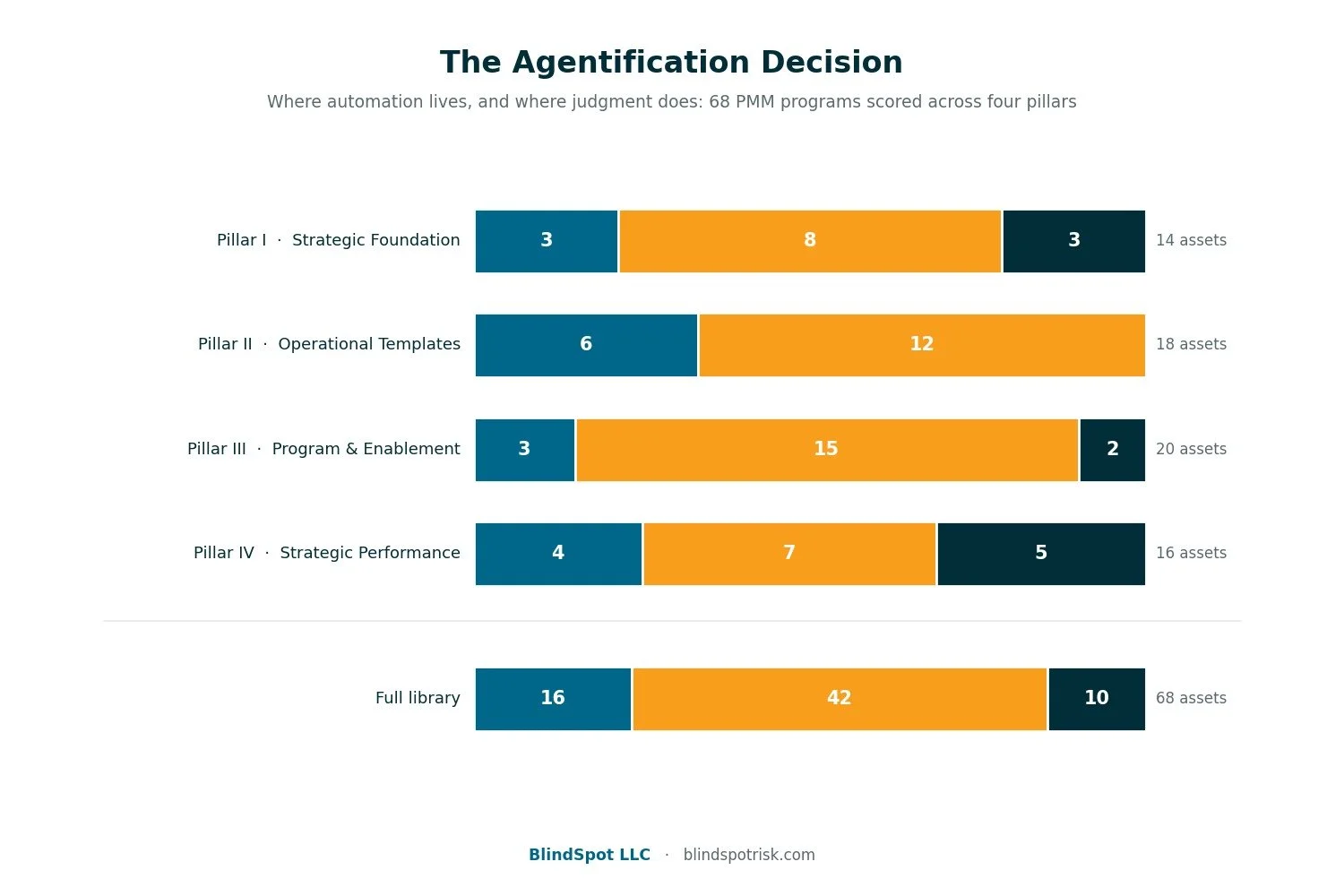
Zone distribution across the four pillars of a 68-asset PMM operating system.
They are not scattered randomly, in other words. The Protect assets concentrate at the two altitudes where product marketing earns its seat: the strategic foundation the whole function is built on, and the executive-facing work where PMM speaks in the language of the business. That is not a coincidence. It's the shape of where senior product marketing value actually lives.
The ten that stay human
It's worth sitting with the Protect zone, because it's the part of this exercise that keeps the rest of it honest. A senior PMM leader's instinct, faced with a mandate to "use more AI," is often to prove enthusiasm by automating something visible. Resist it. The programs in the Protect zone are where you should be spending the hours the other sixty free up, not looking for ways to hand them off.
Positioning is the clearest case. An agent can generate a hundred positioning statements before lunch. Not one of them carries the organizational conviction that makes positioning actually hold, because that conviction comes from a human having made a hard choice about what the company will and will not be, and having sold that choice internally until it stuck. The artifact is downstream of the judgment. Automate the artifact and you're left with a document nobody fought for, which is to say a document nobody will defend when a competitor or a big customer pushes on it.
The same logic runs through the rest of the zone. Board communication is an act of accountability, and accountability cannot be delegated to a system that can't be held responsible. Pricing decisions live at the intersection of finance, product, and market reality, and the judgment that balances them is the job. These are the assets AI shouldn't touch, and knowing which they are is itself a competitive advantage, because it tells you exactly where your scarce senior attention belongs.
What comes next
This post is the map. The series that follows walks the territory. Each subsequent post takes one qualifying initiative, a single program or a correlated cluster, and breaks down exactly how it gets agentified: what moves to the Automate zone, what stays Augment, and where the human boundary sits. Each will also get concrete about the build itself, the agent topology, the execution environment, the integrations, and the orchestration, so the posts describe architecture rather than aspiration.
The competitive-intelligence engine is first, because it's the strongest agentification story in the entire library and the one where the resource-cost and cadence tradeoffs are most instructive.
The decision comes before the build. Before you agentify anything, you score everything, qualify honestly, cluster by correlation, and sequence by leverage. That sequence is the difference between a function that uses AI and a function that's been rearchitected around it.
The series
Each entry below takes one cluster of the library and breaks down what gets agentified, what stays human, and what it costs to run.
The Competitive Intelligence Engine: how seven competitive programs become one agentic system.
The Content and Demand System: why automating production is the easy part, and governing it is the job.
The Measurement Spine: automating the dashboard, and why the attribution argument stays human.
The Market Intelligence Layer: agents can hear the whole market; deciding what it means stays human.
The Sales Enablement Fabric: the asset isn't the point, adoption is.
The Protect Zone: what you should refuse to agentify, and why.
If your product marketing function is under pressure to show AI progress and you want a rigorous answer to where it actually belongs, that's the assessment BlindSpot runs. We score your programs, map them to the Automate, Augment, and Protect zones, and hand you a sequenced build plan tied to your scale and your economics rather than a vendor's roadmap. It's how you turn an AI mandate into GTM infrastructure that compounds. Start with a conversation about where your function stands today.