When a Launch Misses, Look for Where It Broke
The launch is live. The press release is out, the website tells the new story, the product has its name, and the sales team has been briefed. A few weeks in, the signal coming back is wrong. First calls run long because prospects cannot tell what the product does. Deals that were on track for the quarter slip to the next one. Inbound traffic lands on the new homepage and leaves. A competitor's reps have started telling your prospects that you do not seem to know what you are.
At this point, companies tend to make one of two opposite mistakes. The first is treating a structural failure as a copy problem. The team rewrites the headline, refreshes the deck, and waits for conversion to recover. It won't. The second is treating a contained failure as a crisis. The team renames the product, hires an agency, and plans a relaunch that tells the market the first attempt was wrong. Both mistakes have the same cause. The team judges the problem by how bad the launch feels, not by where it started.
Where a failure starts determines how big the fix has to be. If the problem starts in how the product is described, you can fix it in place within a few weeks, and no one outside the company will notice. If it starts in who the product is for, you'll need to reposition, and a relaunch may be the right call. Underneath both is the question of who owns the launch. A failure there affects everything above it. The hard part is finding where the problem starts before choosing the fix. This post covers how to confirm a launch missed, trace the miss to where it started, and size the fix to match.
Who noticed, and who it costs
Six groups can notice a launch that missed: prospects, customers, employees, analysts, investors, and competitors. They don't matter equally. The loudest are rarely the ones costing you the most revenue.
Prospects already in the funnel matter most. Some were mid-evaluation when the story changed. Others came in through the new story and can't make sense of it. Confused prospects rarely tell you they are confused. They ask for another demo, bring in another stakeholder, add a vendor to the shortlist, or go quiet. The damage shows up as longer sales cycles and more no-decisions. Pipeline reviews usually blame the economy or the seller. They rarely blame the launch.
Next come the leads arriving through your primary channels, which for most B2B SaaS companies means the website. These are the people the launch was meant to attract. If the message doesn't land, you lose them before sales even knows they existed. Nobody writes a lost-deal note for a visitor who read the homepage, didn't see their problem on it, and went back to search. The only evidence is in conversion rates, and only if someone is looking.
Competitors are third, and they act fastest. When a launch overclaims, contradicts itself, or borrows a phrase another vendor already owns, competitors get a ready-made objection. A half-updated website becomes a screenshot in someone else's battlecard. A confusing product name becomes a talking point: they cannot even tell you what it does.
Customers, employees, analysts, and investors are also affected, but they can be reached directly. You can call a customer, brief an analyst, hold an all-hands, and put a paragraph in the investor update. Prospects in the funnel and anonymous website visitors cannot be reached that way. You can only change what they see. So judge every fix first by what it does for those two groups. A repair that impresses the board but leaves the funnel unchanged is the wrong repair.
How you know a launch missed
A launch can only miss if there was a target, and a surprising number launches go without one. If nobody wrote down what success should look like at 30, 60, and 90 days, the company ends up judging the launch by mood: the CEO's reaction to the press coverage, a loud seller's complaint, one lost deal that stung. The missing criteria are a finding in themselves. They usually point to the ownership failure covered below.
Where criteria do exist, the most useful are leading indicators tied to the audiences that matter most. For prospects in the funnel, that means stage-to-stage conversion, sales cycle length against the pre-launch baseline, the no-decision rate, and what prospects ask on first calls. For the website, it means comparing engagement and conversion on the new pages against the pages they replaced, and checking whether search traffic for the new product terms is arriving at all. Competitors reveal themselves in their battlecards and in what your sellers hear in deals. For customers, watch the questions they send CSMs and how many adopt or upgrade to what the launch offered. For employees, watch adoption: are sellers using the new deck and talk track, or quietly going back to the old ones? Analyst and investor reactions are worth tracking, but they lag and rarely predict revenue.
The harder judgment is separating a slow ramp from a miss. Enterprise sales cycles are long, and a launch that has not produced closed revenue in its first quarter has not necessarily failed. The difference is in the quality of the signal more than its volume. In a slow ramp, the right buyers are engaging, asking informed questions, and moving through the stages. There are just fewer of them than planned, or they're moving more slowly. In a miss, the wrong buyers engage, the right buyers are confused, first calls are spent re-explaining, or nothing moves at all. A slow ramp calls for patience and more investment in what is working. A miss calls for a diagnosis.
That diagnosis is where teams go wrong next, because different root causes produce similar symptoms. A stretched sales cycle can mean the positioning is wrong, the field is not using the new positioning, or the product does not fit the segment it was launched into. The same evidence that confirmed the miss can also tell the causes apart, if you look at where the funnel breaks. A drop at the top of the funnel points toward messaging. A drop later, once buyers understand the product, points toward proof, pricing, or fit. Win/loss interviews with deals lost since the launch show what the buyer believed they were buying. Two weeks with that evidence will tell you more than a month of executive opinion. It also prevents the most expensive misdiagnosis, which is renaming a product or rebranding a company to fix a problem that lives somewhere else.
Seven ways a launch misses
Most launch failures trace back to one or more of seven root causes. They're ordered here by severity, meaning how much damage each does and how far that damage spreads to the others. Ownership comes first because without it, the other six reach the market unchecked. Enablement comes last because it's the fastest to repair, not because it's minor.
Ownership and orchestration that nobody held
This is the most damaging failure because it sits underneath the others. Without an owner, nobody catches the other six before the market does.
Its symptoms are gaps and seams. The press release went out before the website was ready. The pricing page contradicts the announcement. The metadata still describes the old product. Customers learned about the launch from the press before their CSM told them. Every piece shipped, but not together and not as one story.
In most of the launches I get called into after the fact, the root cause is ownership. Product owned the feature and the ship date. Communications owned the press release. The CEO owned the headline. Web owned the homepage. Each delivered on time. Nobody owned the questions that cut across all of them. Is this claim true? Is it ours alone? Can we prove it? Is every audience ready to hear it on the same day? Those questions are the heart of what product marketing is supposed to do. When product marketing joins after the big decisions are made, nobody asks them, and the launch goes out anyway.
The fix is organizational, and it has to come before any other fix. Name one owner for the whole launch, with authority over the claim, the timing, and readiness. Set readiness gates the launch has to pass: research complete, positioning tested, field certified, every page migrated, installed base briefed. If the same structure that produced the launch runs the repair, the repair will have the same gaps.
Product-market fit that was assumed
Marketing can't fix this failure, yet it's the one marketing is most often asked to fix.
The telltale symptom is that prospects understand the product and still don't want it, or don't want it badly enough to buy now. Messaging changes do not move conversion. Pilots run and do not convert. The customers who did buy are not using the product much. When the problem is messaging, clarity improves results. When the problem is fit, clarity just helps the buyer reach "no" sooner.
The root cause is launching into a segment where the problem isn't painful enough, or where the buyer already has something that solves it well enough. Launch dates set by the roadmap or the fiscal calendar make this more likely, because the date arrives whether fit has been proven or not.
The fixes are larger than a marketing team can make alone. Sometimes fit exists in a narrower segment than the launch targeted. The fix is to reposition toward the buyers who are converting and stop spending on the ones who aren't. Sometimes packaging is the problem, and the product fits as part of a bundle but not as a standalone purchase. Sometimes the right move is to pull the launch back to a controlled program with design partners until the evidence is there. When fit is the root cause, repositioning is justified, and sometimes so is a relaunch toward a different buyer. Polishing the message is not.
Market research that was skipped, or done to confirm
The symptoms of a research failure show up everywhere else. The headline claim turns out to belong to a larger competitor who said it first. The product name means something else in the buyer's vocabulary. The persona the launch was written for isn't the one who signs. The target segment doesn't buy in the volume the plan assumed.
The root cause is rarely that nobody did research. More often it was squeezed to fit the launch date, designed to validate a decision already made, or replaced by gut feel and a few sales anecdotes. Research done to confirm a plan finds what it was looking for.
The fix is to do the research now. Whatever else turns out to be broken, this is almost always the first step. Interview prospects from deals in flight and deals lost since the launch. Audit what competitors are claiming, and when they started, so you know which phrases are already taken. Study the language buyers use for the problem before deciding what to call the solution. Research doesn't repair anything on its own, but every other fix on this list depends on it. Skip it a second time and the relaunch will repeat the first launch's mistakes.
Positioning and messaging that did not land
This is the most common failure and, fortunately, usually the most fixable. It helps to separate the two disciplines, because they fail differently and the fixes differ in size.
A positioning failure means the frame is wrong. You picked the wrong competitive alternative, claimed a category full of vendors you can't beat, or led with a differentiator buyers don't value or can't verify. The symptoms are buyers who treat you as interchangeable ("everyone says that"), deals that come down to price, and competitors who can make the same claim word for word. A messaging failure means the positioning is sound but the words aren't. Think jargon, a headline about technology instead of outcomes, or a value proposition the buyer can't repeat after the call. The symptom is prospects who get it when a seller explains it, but not from the website or the deck.
There's also a third version that is neither: incomplete coverage. The homepage carries the new story; the product pages, use-case pages, page metadata, and social preview tags still carry the old one. A buyer who clicks one level deeper, or opens a shared link, meets the company as it was before the launch. The conclusion they draw is that the marketing changed and the product did not.
Messaging and coverage fixes are incremental and happen in place. Rewrite the headline around the claim you can own, move your strongest proof point to where buyers will see it, finish migrating every page, and fix the metadata. None of it needs an announcement. A positioning fix is bigger. It changes who you compete against and how buyers evaluate you, so it has to reach the sales deck, the battlecards, the analyst briefing, and the pricing page all at once. Even so, it usually does not need a public relaunch. The market experiences it as the company becoming clearer.
A brand the launch outgrew or contradicted
Sometimes the launch was sound and the brand around it was not. A company known for one thing launches something its brand makes hard to believe, and buyers discount the product because of who's selling it. Or the launch narrows the story to a new segment, while the business still earns revenue from the segments that story leaves out. Or the new product makes the company's look and voice suddenly seem dated.
The root cause is usually that the strategy changed and the brand decision never happened. The product team built something that moves the company somewhere new, and nobody asked whether the company's identity should come along.
Most of the fixes that belong in launch recovery happen at the product level. A descriptor can tie the new product to what the company is already trusted for. A new product can carry its own sub-brand, endorsed by the parent, to earn credibility in a new market without changing the whole company. In some cases the product needs a new name that fits the brand architecture. Each can be done in weeks, and none asks prospects in the pipeline to relearn who they're dealing with.
A company rebrand is a different kind of decision, and it should not be made as a launch fix. It takes months, costs far more than any other repair on this list, and reaches every audience at once, including the prospects mid-evaluation who matter most. It also cannot fix a positioning error. A rebrand amplifies whatever positioning sits underneath it. A new name and logo will just carry the same weak claim to a bigger audience, at a much higher cost.
Sometimes, though, the launch did not cause the brand problem. It exposed one. The company had already moved on. It entered a new category, grew a portfolio its name no longer describes, or merged with another company through an acquisition. The launch was simply the first time the market saw the gap. In that case a rebrand may be right. Treat it as a strategic decision on its own timeline, made after the fit and positioning questions are settled. The launch is the evidence for that decision. It is not the reason for it.
A product name that works against the product
Executives blame names more often than names deserve. But when a name is the problem, the evidence is hard to miss. Sellers spend the start of every call explaining what the product does not do. The wrong buyer takes meetings because the name sounds like their job. The right buyer ignores it because it sounds like someone else's software. Prospects confuse it with a competitor's product. Legal raises a trademark conflict. The name translates badly in a market you sell into, or it breaks the logic of the rest of the portfolio.
The root causes are predictable. A committee picked the name because it sounded good in the room. A coined word picked up the wrong meaning from the buyer's vocabulary. Nobody screened it for language or trademark issues. And there was no naming architecture to say how products relate to each other and to the company brand.
The fixes range in size. The smallest is adding a descriptor that explains what the name doesn't, and that often works. If the name has to change, change it once and change it soon. Every week it stays, it collects more contracts, integrations, help articles, partner materials, and search equity. Choose a replacement anchored in words the buyer already uses, and test it against their vocabulary before anyone designs a logo. Tell the affected audiences first. Give sellers a one-paragraph explanation they can say out loud, and make sure customers hear it from their CSM before the website changes. Treat the external change as a correction rather than an event. A release note and an updated product page are usually enough.
Enablement that treated the field as an audience
An enablement failure shows up in behavior. Sellers revert to the old deck within weeks. Five reps pitch the product five different ways. Sales engineers demo the old workflow. CSMs cannot answer a customer's question about what the launch means for their contract. Partners are still selling last year's story.
The root cause is enablement run as an event: a briefing the week of launch, a deck in the content library, and an assumption that the field will adopt it. Sellers adopt what helps them close deals this quarter. A message they haven't practiced, can't defend under objection, and have no proof for doesn't qualify. When enablement comes after the launch, the field learns the story at the same time as the market.
Enablement failures also matter because they're often mistaken for positioning failures. Before deciding the new message doesn't work, check whether the field is actually using it. Listen to calls. A message that has not been delivered has not been tested.
The fixes are usually incremental and fast. Give sellers a talk track they can use in current deals, with a straight answer to "why did your messaging change?" Practice and certify reps before they take the new story to live prospects. And plan for the installed base, so customers hear from their account team before they hear from the market.
The deeper it starts, the bigger the fix
Once you know where a failure started, the size of the fix follows. Think of the seven causes as layers running from the surface of a launch down to its root. The deeper the layer, the more of the launch depends on it, and the bigger the fix it takes.
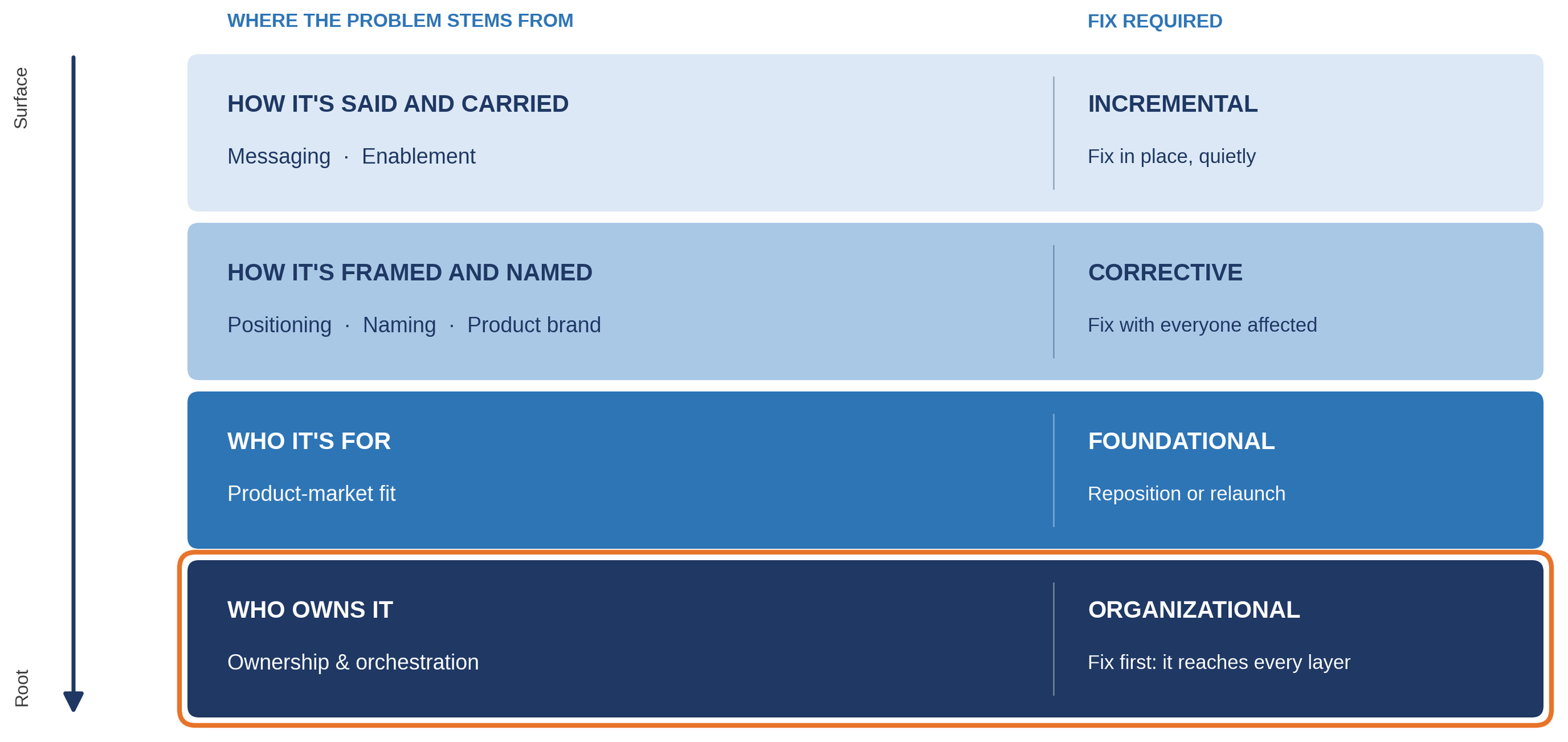
At the surface is how the product is said and carried: messaging, coverage, and enablement. Failures here call for an incremental fix. It happens in place, over weeks, on your own channels and in your own sales conversations. It needs no announcement. The best outcome is that nobody outside the company notices a correction was made.
One layer down is how the product is framed and named: positioning, naming, and product-level brand. Failures here call for a corrective fix. The affected audiences will see it, so handle it with them directly: sellers, customers, partners, and analysts if the competitive set changes. The external signal should be proportionate. An updated page and a release note, not a press cycle.
Below that is who the product is for. A product-market fit failure calls for a foundational fix. This is where repositioning, or a full relaunch toward a different buyer, belongs. A quiet fix would be the mistake here. A fit failure patched with copy changes will keep costing pipeline while the company works on the wrong problem.
At the root is who owns the launch. An ownership failure calls for an organizational fix. It comes first because it affects every layer above it. A missing owner lets messaging drift, positioning go untested, and fit go unexamined, all at the same time. Fix any single layer without fixing ownership, and you've treated one symptom while leaving the cause in place.
A company rebrand is not a layer in this picture. Product-level brand fixes (a descriptor, a sub-brand, a product rename) sit in the framing layer and belong in launch recovery. A company rebrand does not. If the launch revealed that the company's identity no longer matches its strategy, take that to the executive team and decide it on its own timeline, apart from the repair work.
Three questions usually locate the layer. Do prospects who understand the product want it? If not, the problem is fit, and no messaging change will solve it. Is the problem contained to your own channels and conversations, or does fixing it change who you compete against? If it's contained, the fix is incremental. If it changes the competitive set, the fix is at least corrective. Has the company's strategy changed, and is there evidence the new strategy works? If both are true, a relaunch may be justified, and possibly a separate rebrand decision. If only the embarrassment has grown, it is not.
Most launches that miss have more than one broken layer, so the fixes stack. The order still matters. Name the owner first, because every other repair runs through them. Then turn to the prospects in the funnel, because that's where you're losing revenue this quarter. Get sellers a working talk track and a counter to whatever competitors are saying. Next, fix what inbound visitors see. Every day the website tells a broken story, it loses buyers you'll never meet. Brief customers, employees, and analysts directly and in parallel. Then take on the structural work (research, positioning, naming, and product-level brand fixes) with evidence in hand and that owner accountable for the result.
If your launch is live and the signal coming back is wrong, start by finding where it broke. BlindSpot's GTM Diagnostic is a quick way to see which layers need attention. If you'd rather talk it through, reach out, and we'll trace the miss to its root before anyone books the relaunch.