Product marketing has become one of those functions everyone agrees is important—usually right after something breaks.
A launch underperforms. Sales decks start to diverge. Messaging sounds different depending on who you ask. Competitive losses show up without clear explanations. Suddenly, the organization realizes product marketing isn’t just missing—it’s been quietly doing unpaid labor through founders, sales leaders, and product managers for months.
What’s changed isn’t the value of product marketing. It’s the cost of getting it wrong.
In 2026, hiring product marketing is no longer about filling a role. It’s about deciding what kind of organization you’re building, how you expect growth to happen, and whether your marketing engine can keep up with the complexity you’ve created.
This piece is written for CMOs, VPs of Marketing, and founders who sense that product marketing is underpowered or misaligned—but aren’t convinced that simply “adding a PMM” will fix it. We’ll walk through how the function evolves as companies scale, what experience and personal attributes matter at each stage, how teams should be structured, and when it makes more sense to bring in external leadership rather than hiring internally.
Hiring breaks down when organizations optimize for roles instead of systems—this is exactly what Engine for Scale is designed to address.
Product Marketing Doesn’t Scale Linearly — It Evolves
One of the most common mistakes companies make is assuming product marketing scales the way other functions do. Add products, add PMMs. Add revenue, add headcount. In practice, that approach usually leads to fragmentation rather than leverage.
Product marketing evolves because the nature of the problem changes.
Early on, the challenge is clarity. Later, it’s alignment. Eventually, it’s credibility.
While revenue thresholds are often used as shorthand for maturity, they’re a blunt instrument. What actually drives product marketing evolution is organizational complexity: more buyers, more stakeholders, more competitive pressure, and higher expectations from the market.
Across companies, product marketing maturity tends to shift along four dimensions:
What the function is responsible for
How it supports growth
How it’s structured
How insight and intelligence are generated and shared
Those dimensions don’t reset as you grow. They accumulate. The work product marketing does at $20M ARR becomes the foundation for what it’s expected to deliver at $100M and beyond.
For additional perspective on why these early foundations matter later, see How Product Marketing Can Drive Growth and Success for Your Organization on the BlindSpot blog.
A Personal Perspective: Before Product Marketing Had a Playbook
I first encountered the need for a formal product marketing function in 2013—before the discipline was well defined, and long before there were frameworks, certifications, or communities built around it.
At the time, I was leading a technical pre-sales organization for a B2B SaaS portfolio provider with a growing and increasingly complex product set. The company was scaling, demand was increasing, and the default response was the same one many organizations still reach for today: hire more people.
But it wasn’t working.
Every new hire solved a short-term problem and created a long-term one. Knowledge lived in individuals instead of systems. Messaging changed depending on who was in the room. The same questions were being answered repeatedly, slightly differently, every time.
I remember trying to research how others had solved this. I did what anyone would do—I Googled it.
There were three results.
Not three pages. Three links.
What became clear very quickly was that this wasn’t a staffing problem. It was an operating problem. We didn’t need more bodies; we needed a fundamentally different way of working. A way to capture insight once and apply it repeatedly. A way to translate technical complexity into consistent, scalable narratives.
What we eventually built resembled what we now call product marketing—but at the time, there was no clear definition. We built it by necessity. We refined it through trial and error. And we learned quickly that when product marketing is designed as a system rather than a role, scale becomes possible without linear headcount growth.
That experience shaped how I think about product marketing to this day. My perspective isn’t rooted in theory or trend analysis. It comes from living the reality of building teams and programs from the ground up, refining them as the business evolved, and watching the downstream impact when clarity replaced improvisation.
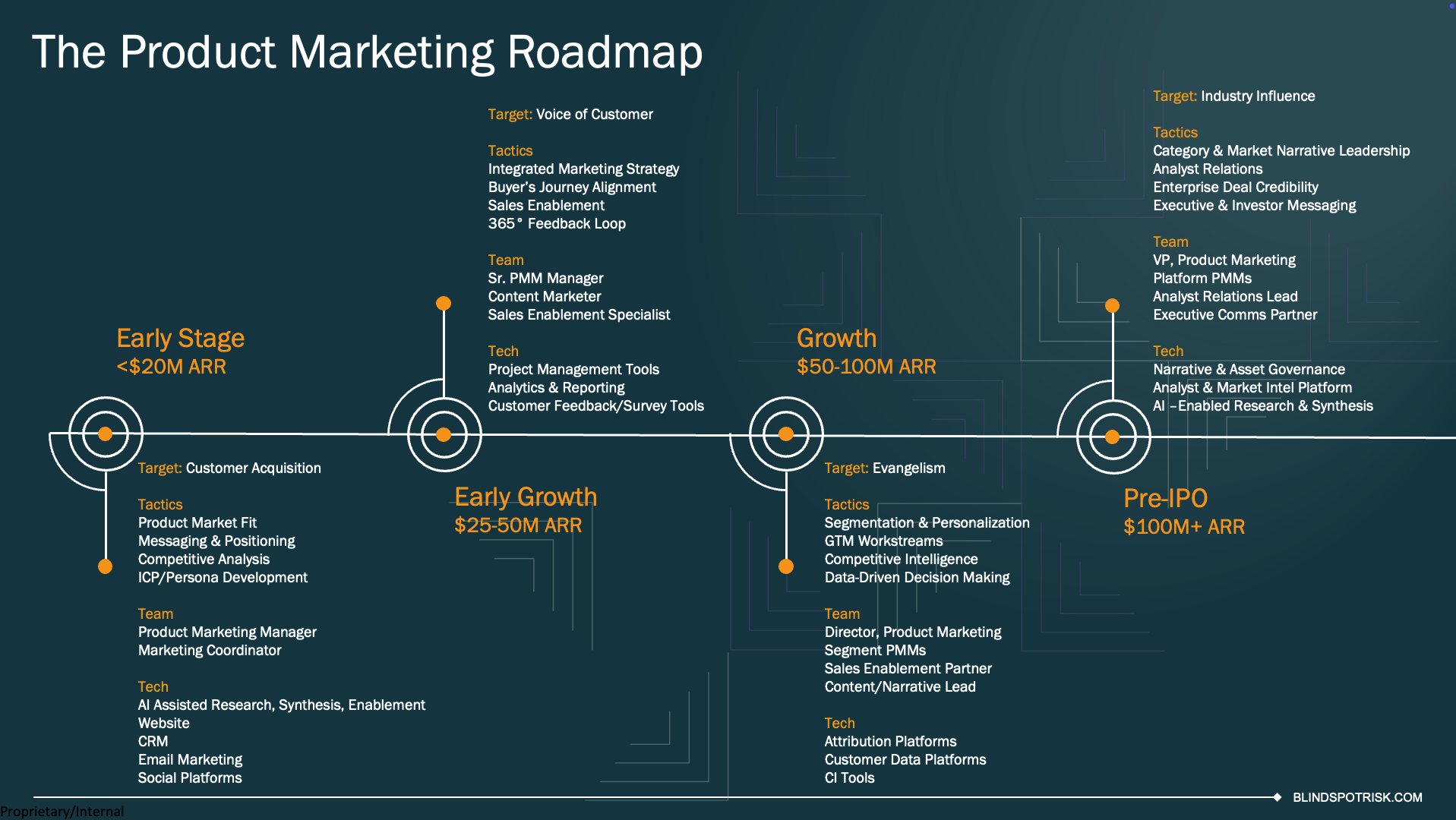
Product Marketing Evolution Aligned to Company Growth
Early Stage: Establishing Signal Where There Is Noise (<$20M ARR)
At the earliest stage, product marketing exists to answer uncomfortable questions.
Who is this really for?
What problem are we solving—specifically?
Why should anyone choose us over the alternatives?
This is not a period for polish. It’s a period for signal extraction.
Most early-stage companies already have opinions about their market. Product marketing’s role is to pressure-test those opinions, synthesize patterns, and turn intuition into language that can actually be repeated.
The strongest early PMMs don’t arrive with playbooks. They arrive with curiosity. They know how to talk to customers, read between the lines, and translate qualitative insight into messaging that resonates before there’s enough data to “prove” anything.
Typically, this role is held by a single Product Marketing Manager, sometimes supported by a marketing generalist or coordinator. Reporting lines vary, but alignment matters more than org charts.
What separates effective early PMMs from ineffective ones isn’t pedigree—it’s tolerance for ambiguity and the ability to think structurally without relying on process.
Early Growth: Becoming the Internal Voice of the Buyer ($25–50M ARR)
Somewhere between initial traction and repeatable growth, a shift happens.
Sales teams expand. Customer success formalizes. Product velocity increases. And suddenly, everyone has a perspective on what customers want—often based on partial information.
This is where product marketing begins to act as the internal voice of the buyer.
The function moves from definition to representation. Instead of simply articulating what the product is, product marketing helps the organization understand how buyers move, what slows them down, and where confusion creeps in.
At this stage, product marketing becomes deeply involved in buyer journey alignment, launch planning, sales enablement, and structured feedback loops with Product and Customer Success. Messaging still matters, but it’s now one input into a broader system.
This is also where early cracks appear if product marketing is under-scoped. Without a strong PMM function, sales teams begin creating their own narratives. Marketing campaigns drift. Launches feel reactive. None of this looks catastrophic on its own—but together, it creates friction that compounds over time.
Growth Stage: Evangelism That Actually Moves Revenue ($50–100M ARR)
By the time a company reaches meaningful scale, product marketing’s job changes again.
The target objective at this stage is still evangelism—but evangelism looks very different than it did earlier. It’s no longer about awareness or excitement. It’s about clarity, confidence, and differentiation in increasingly complex buying environments.
Sales cycles lengthen. Competitive pressure intensifies. Product portfolios expand. Deals stall for reasons that aren’t always visible.
This is where product marketing starts influencing how revenue is generated, not just how the product is described.
Segmentation becomes prioritization. Go-to-market shifts from coordination to orchestration. Competitive intelligence stops being static content and starts showing up inside active deals. Win/loss analysis becomes less about reporting and more about insight.
When product marketing is working well at this stage, it reduces friction across the revenue engine. It helps sales focus on the right buyers, equips teams to navigate competitive pressure, and ensures that messaging holds together as complexity increases.
Structurally, this is often where a Director of Product Marketing becomes necessary—not to add activity, but to design how the function operates. Segment-aligned PMMs and a dedicated enablement or narrative partner are common additions.
This is also the stage where many organizations mis-hire by adding headcount before defining structure. As explored in Developing a Competitive Intelligence Program That Scales, leverage comes from systems, not volume.
Pre-IPO: When Market Credibility Becomes the Product ($100M+ ARR)
At pre-IPO scale, product marketing stops being primarily inward-facing.
The organization is no longer just selling products—it’s selling trust.
Buyers expect category leadership. Analysts expect coherence. Investors expect narratives that hold up under scrutiny. Messaging becomes inseparable from legitimacy.
Product marketing now plays a central role in platform-level positioning, analyst relations, executive messaging, and thought leadership. The discipline becomes externally visible, and expectations rise accordingly.
AI-enabled research and synthesis also start to matter here—not as a replacement for judgment, but as a force multiplier. Best Practices for Incorporating AI into Product Marketing Operations explores how this shift is reshaping senior PMM roles.
How Many Product Marketers Do You Actually Need?
One of the most persistent misconceptions is that product marketing should map one-to-one with products.
In practice, that often creates fragmentation.
More effective models align PMMs to buyer segments, solutions, or platforms—especially as orchestration becomes central to value delivery.
The right ratio is less about count and more about where clarity breaks down.
Signs You’re Under-Invested in Product Marketing
Organizations rarely ask whether they need product marketing—they feel it.
Sales teams building their own decks.
Messaging that varies by region or channel.
Launches that underperform without clear explanations.
Founders acting as default product marketers.
These are symptoms, not causes.
For a broader view on how these gaps quietly erode performance, see Addressing Operational Blind Spots: A Key to Effective Marketing.
Hiring Internally vs. Consulting or Fractional Support
In 2026, the question isn’t whether product marketing matters—it’s how to invest without locking in the wrong structure too early.
Internal hires make sense when long-term ownership and institutional knowledge are critical. External support often makes more sense when speed matters, leadership gaps exist, or the function itself is still being defined.
Used well, consulting and fractional leadership don’t replace internal teams—they help them succeed faster.
Build Product Marketing Intentionally
Product marketing isn’t a role you add when things break. It’s a function you design based on how you expect growth to happen.
The strongest organizations don’t ask, “Do we need a PMM?”
They ask, “What does product marketing need to do at this stage for us to scale cleanly?”
If you’re wrestling with that question, BlindSpot helps organizations assess their current state, define the right operating model, and determine whether hiring, fractional leadership, or consulting support will create the most leverage.
Contact us to start the conversation.